Special Issue 2026 Edition
The Asia-Pacific Journal of International Humanitarian Law is a publication of the Institute of International Legal Studies – University of the Philippines Law Center (UP-IILS).
The Journal aims to produce peer-reviewed scholarly articles and book reviews, as well as commentary on significant developments in International Law, and related fields. It has a special focus on the Asia-Pacific region, and is published once a year.

The Asia-Pacific Journal for International Humanitarian Law (APJIHL) is now ACCEPTING paper submissions for its 2026 Edition. The APJIHL is a publication of the Institute of International Legal Studies-University of the Philippines Law Center (UP-IILS). It is now Scopus-indexed and features peer-reviewed scholarly articles, book reviews, and commentaries on significant developments in international humanitarian law (IHL) and related...
 APJIHL is now Scopus-indexed!
We are proud to announce that the Asia Pacific Journal of International Humanitarian Law has been approved for indexing at Scopus, the largest curated abstract and citation database of peer-reviewed literature in the world.
Being Scopus-indexed despite having only started publication in 2020 is a testament to the high level of scholarship that APJIHL facilitates and our unwavering...
APJIHL is now Scopus-indexed!
We are proud to announce that the Asia Pacific Journal of International Humanitarian Law has been approved for indexing at Scopus, the largest curated abstract and citation database of peer-reviewed literature in the world.
Being Scopus-indexed despite having only started publication in 2020 is a testament to the high level of scholarship that APJIHL facilitates and our unwavering...
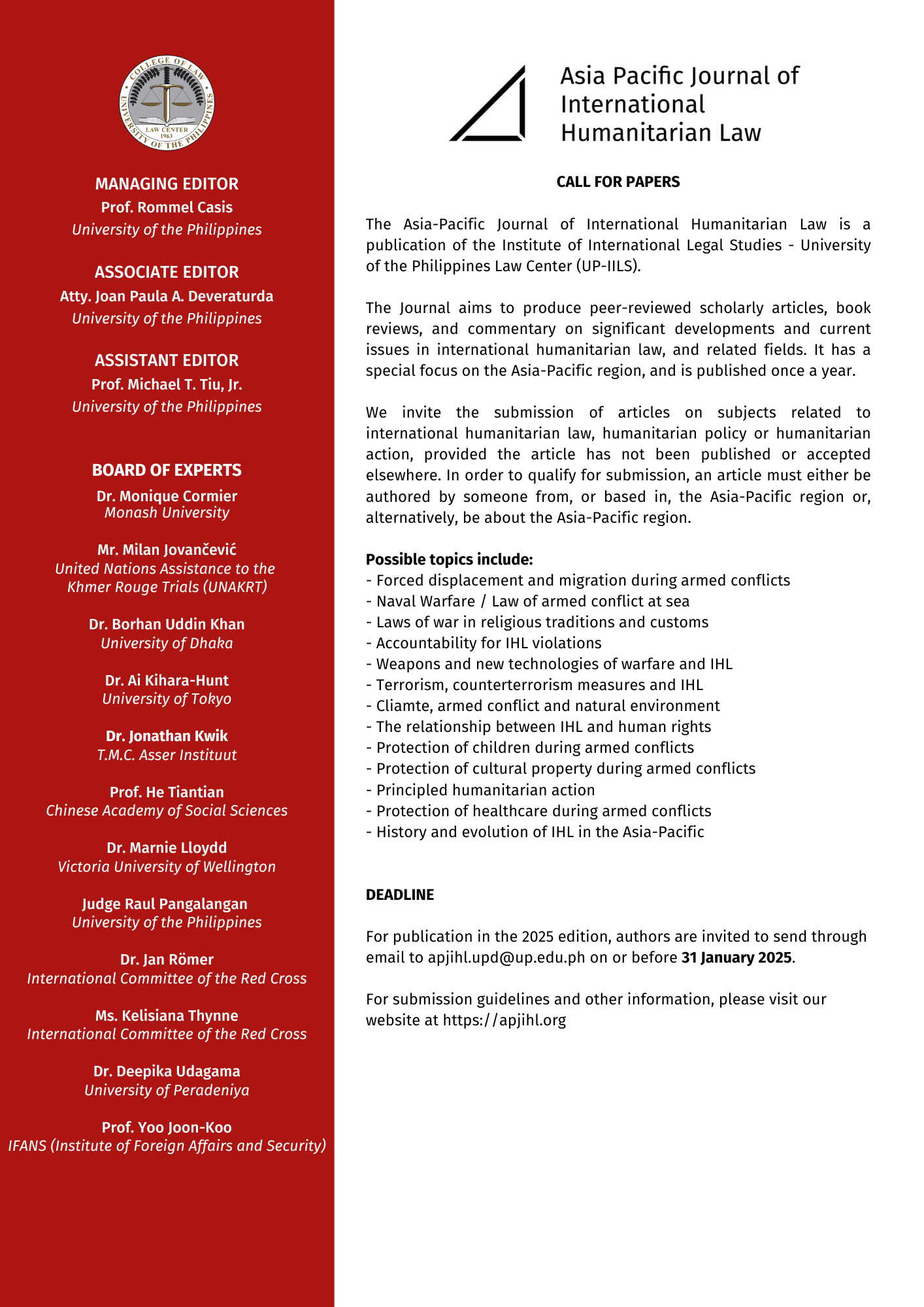
The Asia-Pacific Journal for International Humanitarian Law (APJIHL) is now ACCEPTING paper submissions for its 2025 Edition.
The APJIHL is a publication of the Institute of International Legal Studies-University of the Philippines Law Center (UP-IILS). The Journal has a special focus on the Asia-Pacific region, and publishes peer-reviewed scholarly articles, book reviews, and commentary on significant developments in international humanitarian...
The Asia Pacific Journal of International Humanitarian Law is thrilled to announce that APJIHL Board of Experts member, Dr. Jonathan Kwik, has published a new book for T.M.C. Asser Press entitled, "Lawfully using Autonomous Weapon Technologies.”
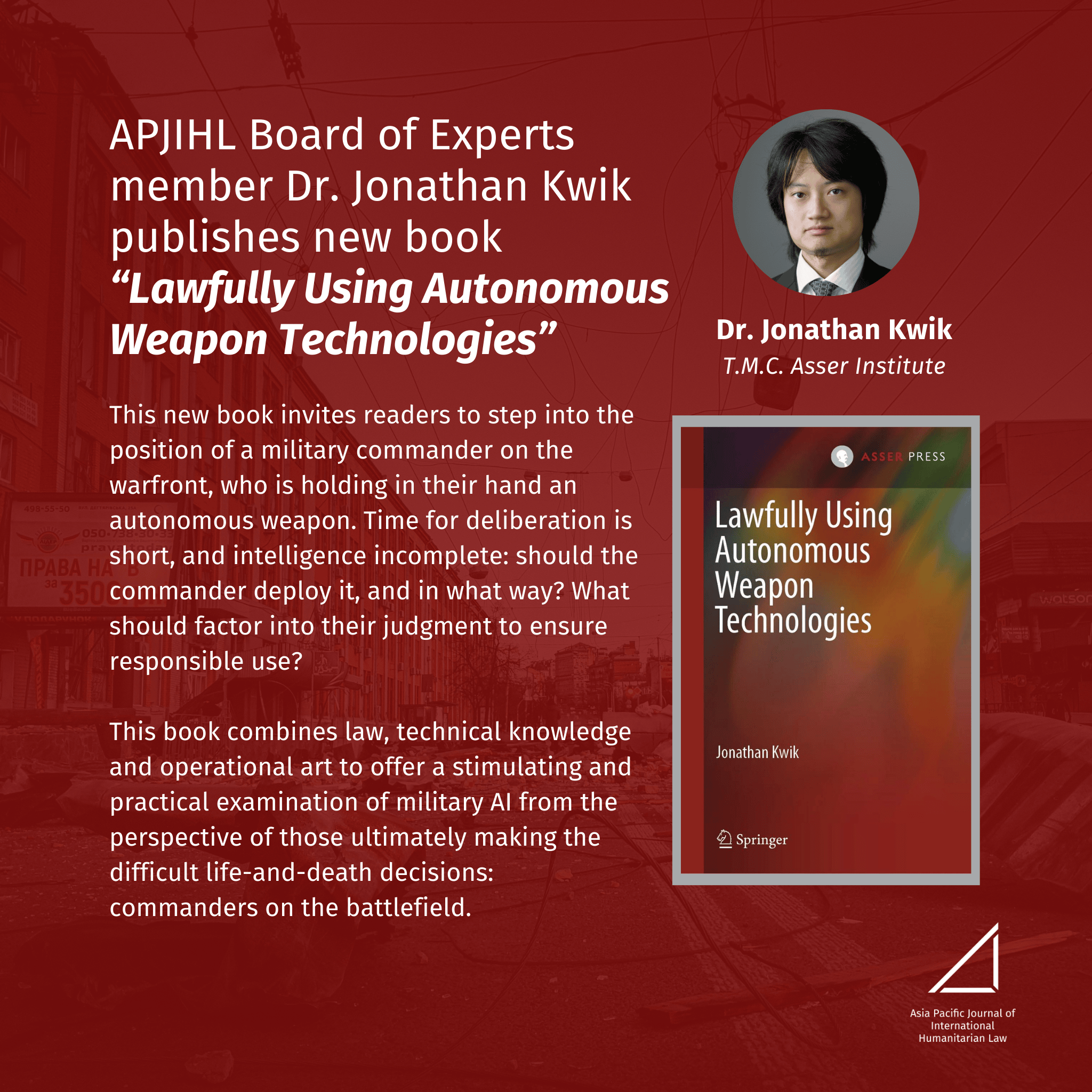 This new book invites readers to step into the position of a military commander on the warfront, who is holding in their hand an...

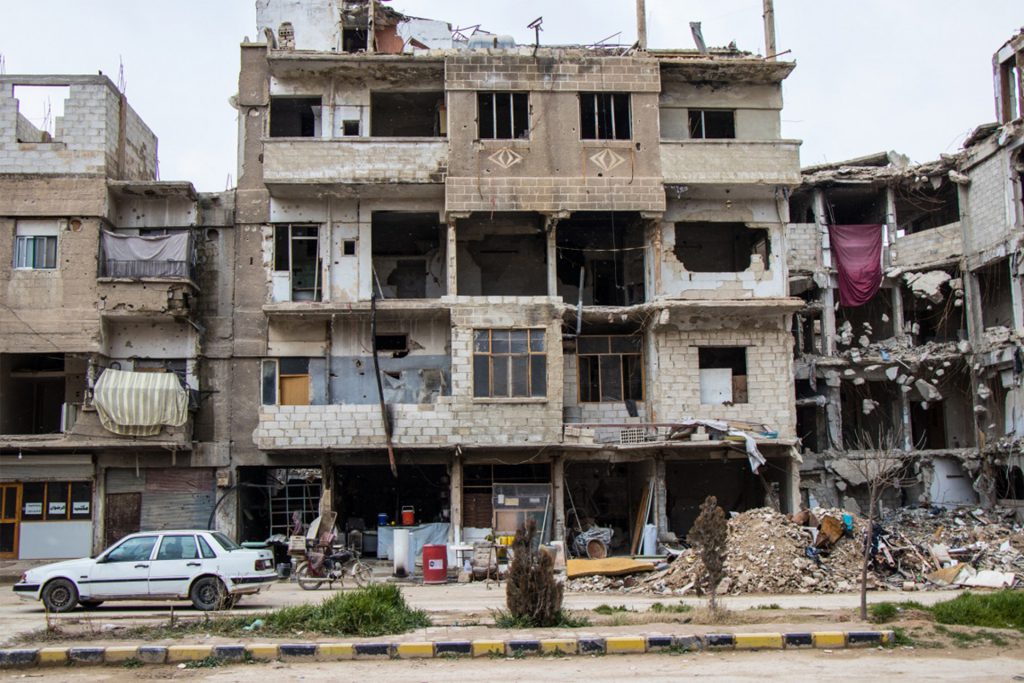
The special issue examines how emerging military uses of artificial intelligence are reshaping contemporary warfare and putting pressure on existing frameworks of international humanitarian law, accountability, and human control.
The Asia-Pacific Journal of International Humanitarian Law (APJIHL) is a publication of the Institute of International Legal Studies-University of the Philippines Law Center (UP-IILS). The Journal seeks to produce peer-reviewed scholarly articles, book reviews, and commentary on significant developments and current issues in international humanitarian law and related fields. It has a special focus on the Asia-Pacific region, and the Regular Issue is published once a year.
The 2026 Special Issue includes the following articles:
Introduction to the Special Issue: Background and Overarching Themes by Samuel WHITE, Jonathan KWIK, Danielle YEOW, & Jon TRUBY
Learned Deception in AI-Enabled Lethal Autonomous Weapons Systems by Dora Vanda VELENCZEI
A Spoonful of Poison: Why the Martens Clause is the Antidote to Pre-Conflict Cyber Mischief by Samuel WHITE, & Daniel HARKER
Coding the Laws of War: Will Treaty-Following AI collapse into the dichotomy between ‘apology’ and ‘utopia’? by Sze Hong LAM
Between Review, Transfer and Principle: The Limits of Article 36, the Arms Trade Treaty and the Martens Clause in AI Warfare by Anviksha PACHORI
Human Dignity and Machine Agency: Reconciling International Humanitarian Law with the Ontology of Artificial Decision-Makers by Sergey SAYAPIN
De Jure Necessity vs. De Facto Improbability? Establishing a New Treaty for Artificial Intelligence in the Military Domain by Zhixiong HUANG, Haokun YU
The Concept of Lethality in the Autonomous Weapon Systems Debate and Its Implications by Mei Ching LIU
Transcending the Dilemma of Applying IHL to LAWS in Agency Spillover Engagements: A Legal Analytical Perspective on Human-Machine Hybrid Agency by Fan YANG
Digital Forensics as a Verification Method for AI-Powered Autonomous Weapons Systems by Drexx LAGGUI
AI in Defence: Implications for Southeast Asia Militaries by Erick Nielson C. JAVIER
Quo Vadis International Humanitarian Law in AI-Enabled Conflicts: A Southeast Asia Regional Perspective by Bagus JATMIKO


© Asia Pacific Journal of International Humanitarian Law